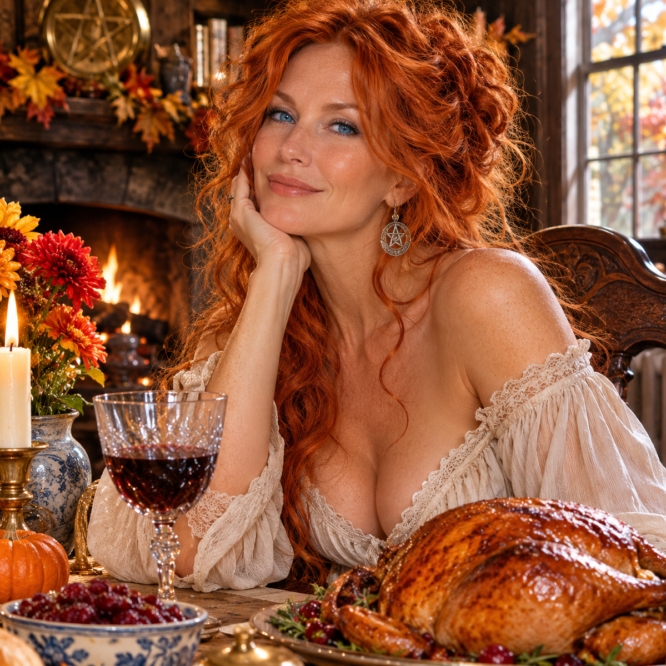
There is something stubborn and good about Thanksgiving. Not merely the food or the long weekend, but the underlying demand it makes: a deliberate pause in the ordinary business of life to acknowledge what has been given, what has been accomplished, and what remains worth keeping. The fast is one small way of keeping that pause from becoming purely ceremonial.
In an age organized around consumption, individual achievement, and the pursuit of novelty, the holiday proposes something different. It asks us to stop. To gather. To prepare something with our hands. To open our homes. To remember that prosperity is measured not only by what we possess, but also by what we share. More than this, it recalls a principle older than any nation: that abundance is never merely the result of human cleverness, and that the proper response to what has been given is gratitude rather than entitlement.
This is why Thanksgiving retains a particular hold on the American imagination. It is among the few occasions on the national calendar that does not fundamentally require a purchase, a performance, or a public declaration. Its central ritual is a meal. Its central virtue is gratitude. Both the ritual and the virtue are European in origin and American in development.
Before There Was an American Thanksgiving
The impulse to give thanks for a harvest belongs to the perennial order of traditional European societies. Agricultural peoples across Europe marked the end of the growing season with feasts, processions, and rites of thanksgiving. England had its harvest-home customs. The Continent maintained its own seasonal observances. Families gathered, agricultural workers celebrated the completion of their labor, and food was prepared from the fruits of the season. A successful harvest was never treated as a purely individual achievement. It was the visible sign of a relationship between man, the land, and the rhythms that govern life.
These customs crossed the Atlantic with English settlers and took root under different circumstances in North America. The familiar American origin is the harvest gathering at Plymouth in 1621. After a hard first year of illness, scarcity, and uncertainty, the English settlers celebrated a successful harvest in the manner of their own people. Members of the Wampanoag, led by Massasoit, were present. Contemporary accounts describe a multi-day event of food, hunting, and military exercises. Venison and wild fowl are documented. The familiar image of turkey, pumpkin pie, and neatly arranged tables belongs largely to later tradition.
The occasion was an English harvest celebration to which others were invited. What matters is that a small European community, having survived real hardship, gathered to acknowledge its blessings and mark the successful continuation of life. That spirit—gratitude after difficulty, the recognition of providence within contingency—became the seed of the American holiday. It is the same spirit that traditional European cultures had long cultivated: the refusal to treat survival as automatic or abundance as a right.
The Making of a National Tradition
Thanksgiving developed gradually in colonial America as an English and later American custom. Individual colonies proclaimed days of thanksgiving in response to military victories, successful harvests, or events regarded as providential. Observances varied. There was no single national date. What existed was a shared European-American understanding that certain moments require a public act of acknowledgment.
The transformation into a national holiday owes much to Sarah Josepha Hale, the nineteenth-century writer and editor who campaigned for a unified annual observance for decades. Hale understood that shared customs are not ornamental. They are the means by which a people maintains continuity across distance and difference. A national holiday, she believed, could encourage domestic affection, strengthen social bonds, and foster a common American identity among people of European descent.
Her efforts eventually reached President Abraham Lincoln. In 1863, amid the Civil War, Lincoln issued a proclamation establishing a national day of Thanksgiving in November. The country was experiencing extraordinary suffering, yet the president called upon Americans to recognize the blessings that remained and to express gratitude even in the midst of national tragedy.
Gratitude was not presented as a reward for fortunate circumstances. It was a discipline to be practiced when circumstances were difficult. In the language of Tradition, it is a form of ascesis—the deliberate orientation of the soul toward what is higher, rather than the passive acceptance of whatever mood the moment produces. That understanding remains among the most valuable things Thanksgiving has to teach.
In 1941, Congress established the fourth Thursday of November as the permanent federal observance. What had once been a collection of regional European-American practices had become an enduring national institution—an imperfect but real vessel for the transmission of a traditional virtue.
The American Thanksgiving Table
If the history of Thanksgiving shows how a national tradition developed from European roots, the dinner table shows how it became personal and, in a deeper sense, ritual.
The meal is a cultural inheritance that brings together European agricultural abundance, regional variation, immigrant traditions, family preferences, and generations of domestic knowledge. Turkey occupies the central place in the popular imagination, accompanied by stuffing or dressing, potatoes, gravy, cranberries, squash, sweet potatoes, and various vegetables. Pumpkin and pecan pies provide the familiar conclusion. There has never been one universally correct menu. New England traditions retain strong associations with the colonial English harvest. In the South, cornbread dressing and regional preparations are common. Elsewhere, family recipes reflect the contributions of later European immigrants—German, Italian, Polish, Irish, Scandinavian, and others.
This is one of the quieter strengths of European-American domestic culture: the national form has room for particular content. A grandmother’s recipe sits beside a dish brought by a later arrival from the Old World. The meal becomes a living record of family history. More than history, it is a form of participation. The preparation of food, the arrangement of the table, the gathering of people who share blood or long acquaintance—these are ordinary acts that, repeated across generations, become the means by which a tradition is kept alive.
There is a distinction between food as consumption and food as hospitality. A Thanksgiving dinner is not simply a collection of dishes. It is an act of preparation and generosity. Someone has planned the meal, gathered the ingredients, cleaned the house, arranged the table, cooked for hours, and considered the preferences of those who will arrive. Much of this work has historically been performed by women, whose domestic labor has too often been treated as incidental rather than recognized as essential to the continuity of family and community. There is a quiet dignity in it. Civilization is sustained not only through institutions and public achievements, but also through the countless small acts of care that make a house a home and a household a place of order.
In a traditional understanding, such acts are not merely practical. They are the visible expression of an invisible order—the correspondence, as the old hermetic language has it, between the work of the hands and the ordering of the soul.
The Customs That Make Thanksgiving American
The holiday has accumulated a collection of customs, some rooted in older European practices and others distinctly American.
The family gathering is the most important. Families travel considerable distances to spend a few hours together. Parents, children, grandparents, siblings, cousins, and old friends reunite around a common table. The arrangement is not always perfect. Families have disagreements, generations have different expectations, and not everyone enjoys the same company. Yet the act of gathering expresses a recognition that relationships deserve attention beyond the ordinary demands of daily life. It is a temporary restoration of a more organic social form against the fragmentation of modern existence.
Many households begin their meal with a prayer or a moment in which guests express something for which they are grateful. The practice is simple, but it introduces an element of reflection into what might otherwise become an entirely material occasion. It reminds us that gratitude is not merely an emotion. It is also a way of interpreting our circumstances—an act of orientation.
Thanksgiving has traditionally provided an opportunity to invite neighbors, acquaintances, and those who might otherwise spend the day alone. The open table suggests that hospitality need not be reserved exclusively for relatives or people who can repay the invitation. It is a limited but real expression of the principle that a household is not only a private refuge but a place that can extend order outward.
The holiday remains connected to the agricultural calendar, even though most Americans now live far removed from agricultural production. The autumn landscape, the final gathering of garden produce, the changing leaves, and the approach of winter give it a seasonal character that is difficult to reproduce at other times of the year. Modern life has largely detached people from these rhythms. Thanksgiving is one of the remaining occasions on which the old European cycle of harvest and thanksgiving is still felt, however faintly.
What Thanksgiving Says About the American Character
There is a tendency to understand American culture primarily through its emphasis on individualism, ambition, enterprise, and personal freedom. These characteristics have contributed to the country’s development. Yet Thanksgiving represents another dimension of the European-American character, one that is sometimes overlooked and that belongs more to the world of Tradition than to the modern ideology of progress.
- It is communal rather than purely individualistic.
- It is domestic rather than commercial.
- It is reflective rather than competitive.
- It celebrates abundance while acknowledging dependence on land, labor, providence, and one another.
The United States has always been a country of movement, migration, and reinvention. Families of European descent have crossed oceans, crossed the continent, left old communities behind, and established new lives in unfamiliar surroundings. Thanksgiving offers a recurring opportunity to create continuity in a society that is otherwise unusually mobile. A person might move thousands of miles from the place of their birth and still recognize the familiar smell of a Thanksgiving kitchen, the arrangement of the table, the traditional dishes, and the gathering of relatives.
In this sense, Thanksgiving is not merely a celebration of American history. It is a mechanism for preserving memory. It allows each generation to inherit something that cannot be adequately conveyed through textbooks or official ceremonies: the experience of belonging to a family, a community, and a shared cultural tradition of European origin. In Jungian terms, it is one of the remaining occasions on which the collective psyche is still allowed a ritual form—an opportunity for the individual to feel, however briefly, the presence of something larger and older than personal desire.
What We Might Regain
The more interesting question is not only what Thanksgiving once was, but what its traditions might encourage us to recover from the world of Tradition.
Modern life has brought extraordinary conveniences, yet it has also weakened certain habits that previous generations regarded as ordinary. We are more connected electronically and often less connected socially. We have more entertainment available than any previous generation, but fewer occasions that require us to participate in something together. We can purchase almost any prepared meal, yet the knowledge and patience involved in preparing food from basic ingredients are increasingly unfamiliar. The result is a culture of novelty without continuity, of stimulation without form.
Thanksgiving provides an opportunity to reconsider these changes.
We might regain the habit of hospitality. The home should be more than a private refuge. It can also be a place of welcome, conversation, generosity, and fellowship. An invitation to dinner need not be elaborate. A modest meal shared sincerely is often more meaningful than an expensive occasion organized for appearances.
We might regain respect for domestic life. There is no reason to regard the ordinary work of maintaining a household as intellectually or culturally inferior to activities performed outside it. Cooking, gardening, preserving food, caring for children, maintaining a home, and keeping family traditions alive require knowledge, patience, discipline, and practical intelligence. These activities deserve respect because they are the ordinary means by which order is maintained against entropy.
We might regain intergenerational relationships. A society that loses contact with its elders loses access to an enormous store of experience. Grandparents and older relatives carry memories, practical knowledge, family histories, and perspectives that cannot simply be recreated. The transmission of recipes, stories, skills, and traditions is a form of cultural inheritance. Without it, each generation begins again in a kind of amnesia.
We might regain seasonal awareness. Modern technology has made it possible to live as though the seasons hardly matter. Yet there is something psychologically and culturally grounding about remaining attentive to the natural world. Planting, harvesting, preserving, preparing, and storing food reconnect us with the rhythms of life. Even a small garden can restore some appreciation for the relationship between effort and abundance, between the visible harvest and the invisible conditions that make it possible.
We might regain the practice of gratitude. Gratitude does not require denying hardship or pretending that everything is well. It requires resisting the temptation to evaluate life exclusively according to what is missing. There is a difference between striving for improvement and being incapable of appreciating the present. The former is healthy ambition. The latter is the restless condition of a soul that has lost its orientation. A fast the day before is only one small expression of this principle. The larger one is the willingness to receive what is given rather than demand that the world continually rearrange itself to suit appetite.
A Tradition Worth Keeping
Thanksgiving is a European-American tradition of gratitude, continuity, and belonging. Its popular origin story has been simplified over time, as most national stories are. That does not make the holiday less worth keeping. A mature people can remember its history without treating every tradition as an occasion for self-accusation. The world of Tradition does not require that the past be perfect. It requires that what is valuable be preserved, even when the conditions that produced it have changed.
We want to belong somewhere. We want to know that our efforts matter to others. We want familiar faces, a welcoming home, a meal prepared with care, and the reassurance that the things we value will not disappear with our own generation. We want a reason to gather that is not dependent upon a commercial transaction, a political disagreement, or an elaborate social performance.
A table, a meal, a few familiar voices, and a moment of sincere gratitude are enough.
Perhaps this is what we ought to preserve—not merely the holiday, but the habits and values that give it meaning. The ability to welcome. The willingness to share. The patience to prepare. The wisdom to remember. The generosity to include. And the humility to recognize that much of what makes life worthwhile has been given to us by others—and by forces older and greater than ourselves.
In the end, Thanksgiving reminds us that a good life is not built entirely through acquisition and achievement. It is also built through stewardship, affection, memory, and gratitude. These are not modern inventions. They are the ordinary forms through which European peoples have long oriented themselves toward what endures.
And those are things worth passing on.