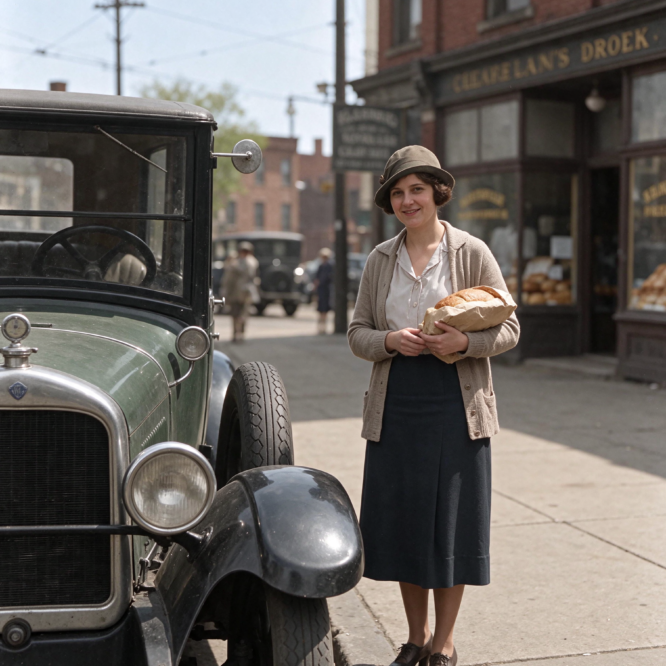
Introduction: The Possibility of Returning
Modern society operates upon an assumption that is rarely questioned: the past is gone, and whatever has replaced it must necessarily be accepted as progress. Old customs disappear, traditional institutions weaken, familiar forms of social life are abandoned, and the resulting changes are presented as irreversible. We are told that we cannot go back.
RetroCulture challenges this assumption.
Developed particularly in the work of William S. Lind, RetroCulture is the rediscovery and practical recovery of valuable ways of living from earlier historical periods. It is not simply an appreciation of vintage aesthetics, nor is it an exercise in sentimental recollection. Its purpose is to restore good things that have been lost: forms of domestic life, family relationships, manners, craftsmanship, education, architecture, entertainment, and community organization.
The central proposition is straightforward: if people once lived well according to particular customs and arrangements, there is no inherent reason why those customs and arrangements cannot be recovered.
This does not mean that every aspect of an earlier society should be reproduced. The past contained injustices, hardships, and limitations that need not be restored. Nor does RetroCulture require the indiscriminate rejection of modern technology. Modern medicine, useful conveniences, and genuine technological improvements can coexist with traditional ways of living.
The essential distinction is between what is genuinely beneficial and what is merely contemporary.
RetroCulture asks us to reconsider the assumption that the present represents the culmination of human social development. It proposes instead that earlier generations possessed knowledge, practices, and standards that remain valuable, and that their recovery may offer a better foundation for the future.
It is, above all, a practical undertaking. Its success is measured not by what people say about the past, but by what they recover and put into practice.
I. Defining RetroCulture
RetroCulture is the conscious rediscovery and restoration of beneficial ways of life from earlier historical periods, through their practical adoption in the present.
The term encompasses much more than clothing, furniture, architecture, or popular entertainment. These are visible expressions of a broader cultural order. RetroCulture concerns the customs, habits, values, skills, manners, institutions, and relationships that once gave everyday life its particular character.
It includes such things as:
- Stronger family and intergenerational relationships.
- The cultivation of domestic life and hospitality.
- Traditional standards of manners, courtesy, and public conduct.
- Craftsmanship, repair, gardening, and practical competence.
- Architecture and neighborhoods designed around human needs.
- Local businesses, community institutions, and civic participation.
- Traditional education, literature, music, and the arts.
- Durable possessions, modest consumption, and an appreciation of quality.
- The preservation of historical knowledge and inherited customs.
These elements are not unrelated preferences. They reinforce one another. A household that cultivates hospitality, for example, participates in a broader culture of sociability. A neighborhood organized around walkability encourages local commerce and repeated personal encounters. Traditional manners support the relationships that make community life possible.
RetroCulture therefore concerns the recovery of a functioning way of life rather than the acquisition of an assortment of historical objects.
It also allows considerable personal choice. One person may prefer the domestic arrangements and architecture of the Victorian period, another the craftsmanship and social customs of the early twentieth century, and another the familiar domestic culture of the 1940s or 1950s. The degree of restoration is likewise a matter of individual preference and circumstance.
There is no requirement to reproduce an entire historical period. The objective is to recover what was good and useful, adapting it intelligently to present conditions.
This is the distinction between living in the past and bringing valuable elements of the past back into our lives.
II. Restoration Rather Than Nostalgia
Nostalgia is often understood as longing for an idealized past. It can be sentimental, selective, and passive. A person remembers a childhood home, an old neighborhood, or the customs of an earlier generation, but the memory remains largely emotional.
RetroCulture takes the next step.
It asks what can actually be recovered.
An old photograph of a family gathered around the dinner table may evoke pleasant memories, but RetroCulture asks why families ate together, what those occasions meant, and why the practice might be worth restoring. An old-fashioned storefront may be visually attractive, but the more important questions concern local commerce, personal service, and the relationship between a business and its community.
The distinction is between admiring an arrangement and participating in it.
The same principle applies to domestic life. A person may admire an old kitchen, but the deeper value lies in cooking, preserving food, maintaining household skills, and making the home a place of hospitality. An appreciation of traditional manners becomes meaningful when those manners are actually practiced.
This is why RetroCulture should not be confused with the vintage consumer market. Buying old objects can be enjoyable, but consumption alone does not restore culture.
Restoration requires action.
It means recovering practices, habits, and standards that can once again become part of ordinary life. It means recognizing that cultural inheritance is not simply something we receive passively. It is something we must maintain and transmit.
The past is not merely an object of contemplation. It is a source of practical knowledge.
III. The Human Scale
One of the most important things that can be recovered from earlier forms of life is the human scale.
For much of history, everyday existence was organized around relatively comprehensible relationships and institutions. People knew their neighborhoods, encountered familiar merchants, participated in local associations, and maintained relationships with extended family members and neighbors.
This did not mean that earlier communities were free of conflict or hardship. They were not. But daily life was often more closely connected to particular places and recognizable social relationships.
Contemporary life increasingly substitutes large, impersonal systems for these immediate relationships. We interact with platforms rather than publishers, corporations rather than familiar merchants, and bureaucracies rather than institutions in which we have personal standing.
The resulting convenience comes at a cost. Local knowledge disappears, practical competence declines, and relationships become increasingly mediated by systems that are difficult for ordinary individuals to influence.
RetroCulture offers a different orientation.
It favors the restoration of local commerce, established neighborhoods, walkable communities, practical skills, and institutions that bring people into regular contact. It recognizes that the quality of life depends upon more than the availability of goods and services.
A neighborhood is not simply a collection of residential properties. It is a place in which relationships develop over time. A local business is not merely a point of sale. It can become part of the social identity of a community. A household is not simply a unit of consumption. It is a place where habits, responsibilities, and relationships are cultivated.
The human scale makes these relationships possible.
It also makes life more intelligible. People can see the consequences of their actions, understand their surroundings, and recognize their responsibilities to others.
The restoration of human-scale living is therefore not an exercise in rejecting modernity wholesale. It is an attempt to recover the social conditions under which ordinary people can exercise greater competence, independence, and responsibility.
IV. The Household and the Recovery of Domestic Life
The household occupies a central position in RetroCulture.
Earlier generations generally understood the home as more than a place in which individuals slept, stored possessions, and consumed products. It was the center of family life, education, hospitality, recreation, and the transmission of culture.
The decline of domestic competence is consequently more significant than the loss of particular household skills. It represents a weakening of the institution through which many customs and traditions were historically transmitted.
Cooking, sewing, gardening, housekeeping, entertaining, and the maintenance of a household are often dismissed as unimportant because they do not necessarily produce wages. This reflects a narrow conception of productive activity.
A well-maintained home, a properly prepared meal, a welcoming table, and the ability to entertain guests are not merely aesthetic accomplishments. They are expressions of competence, generosity, and social responsibility.
The same is true of child-rearing. The household is one of the principal environments in which children acquire language, manners, habits, practical knowledge, and an understanding of their place within a larger community.
RetroCulture recognizes the importance of domestic life without requiring every individual or family to adopt an identical arrangement. The point is not to impose a universal division of labor, but to restore the dignity and cultural significance of homemaking and family life.
Nor should the household be understood in isolation. Its customs connect generations. Recipes, stories, furniture, photographs, religious observances, celebrations, and ordinary domestic habits carry memories and knowledge from one generation to another.
A society that loses these connections becomes increasingly dependent upon institutions outside the family to provide functions that households once performed themselves.
The restoration of domestic life is therefore one of the most practical starting points for cultural renewal.
V. Manners, Form, and the Recovery of Civility
RetroCulture also places considerable importance on manners and the forms of everyday social conduct.
Manners are sometimes dismissed as superficial conventions, but they serve a practical purpose. They regulate ordinary interactions, establish expectations, and make social life more agreeable.
Courtesy, punctuality, appropriate dress, respectful conversation, hospitality, and consideration for others are not merely decorative features of an older society. They are habits through which individuals demonstrate recognition of one another.
A society in which these conventions are widely practiced requires less negotiation over the most elementary forms of conduct. People understand what is expected of them, and ordinary interactions become more predictable and pleasant.
This does not require the restoration of every historical etiquette rule. Some conventions were unnecessarily elaborate, socially restrictive, or poorly suited to modern circumstances.
But the underlying principles remain valuable.
Respect does not become obsolete. Neither does consideration, self-restraint, or the recognition that public conduct should take account of others.
The same argument applies to architecture, clothing, and household arrangement. Form gives visible expression to standards. A well-maintained building, a carefully prepared table, or appropriate public dress communicates that ordinary life deserves attention.
The disappearance of inherited forms does not necessarily produce freedom. It can simply leave individuals subject to the standardized forms of commercial culture and bureaucratic organization.
RetroCulture seeks to restore forms that make everyday life more dignified, intelligible, and humane.
VI. The Recovery of Culture Through Practice
A particularly important aspect of RetroCulture is its emphasis on example.
Cultural renewal cannot be accomplished through declarations alone. It requires people who are willing to live differently.
An individual may begin by changing the character of his household. A family may recover traditional meals, regular hospitality, and shared activities. Neighbors may establish local associations, organize community events, or support independent businesses. A group of families may establish educational, religious, or recreational institutions that reflect their inherited values.
These activities are modest in isolation, but their significance lies in their practical character.
They create functioning alternatives rather than merely expressing dissatisfaction with existing arrangements.
This approach also recognizes that cultural knowledge is acquired through participation. Children learn manners by observing and practicing them. Practical skills are transmitted through instruction and example. Traditions survive because people continue to observe them.
The same principle applies to institutions. A community that wishes to restore traditional forms of education, worship, entertainment, or civic participation must create opportunities for those activities to take place.
The power of example is therefore central to RetroCulture.
People are more likely to recognize the value of an alternative when they can see it functioning successfully. A household that demonstrates the pleasures of domestic life, a business that provides excellent personal service, or a neighborhood that maintains a strong communal identity offers something more persuasive than an abstract argument.
The restoration of culture begins with the restoration of cultural practice.
VII. The Limits of Restoration
RetroCulture does not require the belief that everything in the past was better.
Earlier societies experienced poverty, disease, injustice, social restrictions, and other hardships. Some inherited customs deserve abandonment, while others require modification. Historical admiration should not prevent honest examination.
Nor is there a need to reject every modern development. Scientific medicine, useful machinery, modern sanitation, and other genuine improvements need not conflict with traditional domestic and social arrangements.
The distinction should be made according to utility and human benefit rather than chronology.
A practice should not be rejected merely because it is old, nor accepted merely because it is new.
This is particularly important because historical restoration is not the same as historical reconstruction. The objective is not to recreate a museum environment or reproduce every condition of a particular decade. It is to recover the good things that earlier generations understood and practiced.
Each individual and household must determine what can reasonably be restored within its circumstances.
Some may adopt a relatively modest degree of RetroCulture, perhaps emphasizing domestic skills, traditional manners, and older forms of entertainment. Others may choose a more comprehensive restoration of household arrangements, education, architecture, and community life.
Both are legitimate expressions of the underlying idea.
The important thing is that restoration should be deliberate rather than merely decorative.
Conclusion: Recovering What Is Worth Keeping
RetroCulture begins with a simple recognition: the present does not possess a monopoly on wisdom.
Earlier generations developed customs, institutions, skills, and standards that contributed to the quality and continuity of their lives. Many of these have been abandoned, not because they ceased to be valuable, but because changing cultural assumptions made them appear unnecessary or obsolete.
RetroCulture proposes that we examine this inheritance again.
Its purpose is not to idealize history, nor to retreat into an imaginary past. It is to recover what remains useful, beautiful, and meaningful, and to put those things back into practice.
The household, the neighborhood, the local business, the family meal, traditional manners, craftsmanship, music, literature, and the transmission of knowledge between generations are not relics. They are elements of human life whose value does not depend upon their novelty.
The restoration of culture begins with individuals and families, but it need not end there. Practices that prove their worth can spread through communities and eventually contribute to the renewal of larger institutions.
This is the essential distinction between nostalgia and RetroCulture. Nostalgia remembers what was lost. RetroCulture asks what can be recovered.
We need not accept that everything inherited must be discarded, or that the future can only be constructed by breaking with the past.
What was once lived can, in many cases, be lived again. And what is worth preserving must be practiced, not merely remembered.