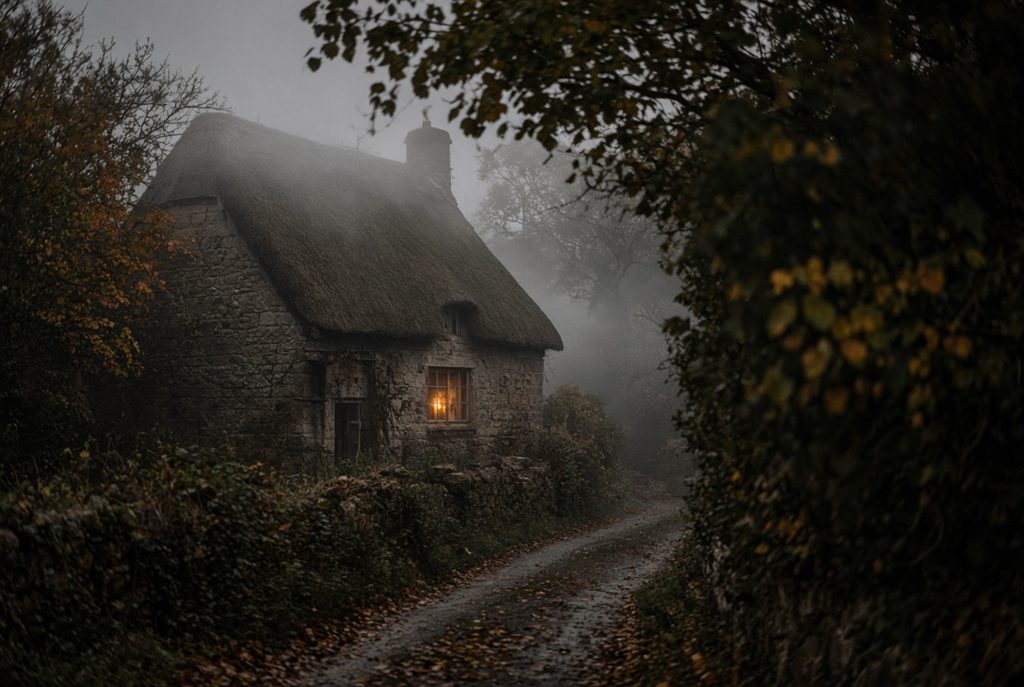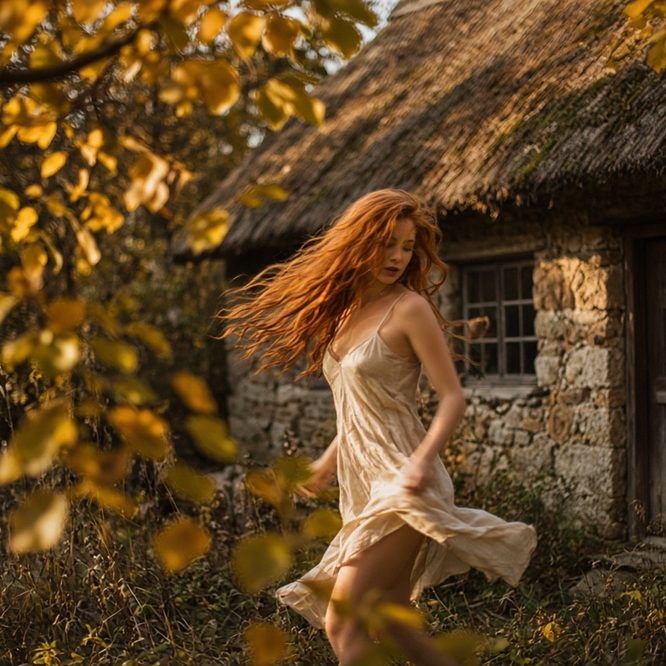
The cottage crouched where the lane narrowed and the hedgerows grew dense enough to hide a body. In autumn the mist rose before first light and clung to the thatch as if it had weight, as if it knew the stones beneath the floor and preferred not to leave them.
The villagers called her a healer of gardens and a finder of lambs. They did not speak of the way the air changed when she passed a gate, or how their children sometimes dreamed of her standing barefoot in the yard, watching the dark between the elder trees. Beneath the floorboards lay a ring of worn stones whose runes had been darkened by more than weather. When the house was quiet she could feel them through the soles of her feet, a slow, low heat that answered the blood in her calves.
Before Sunrise
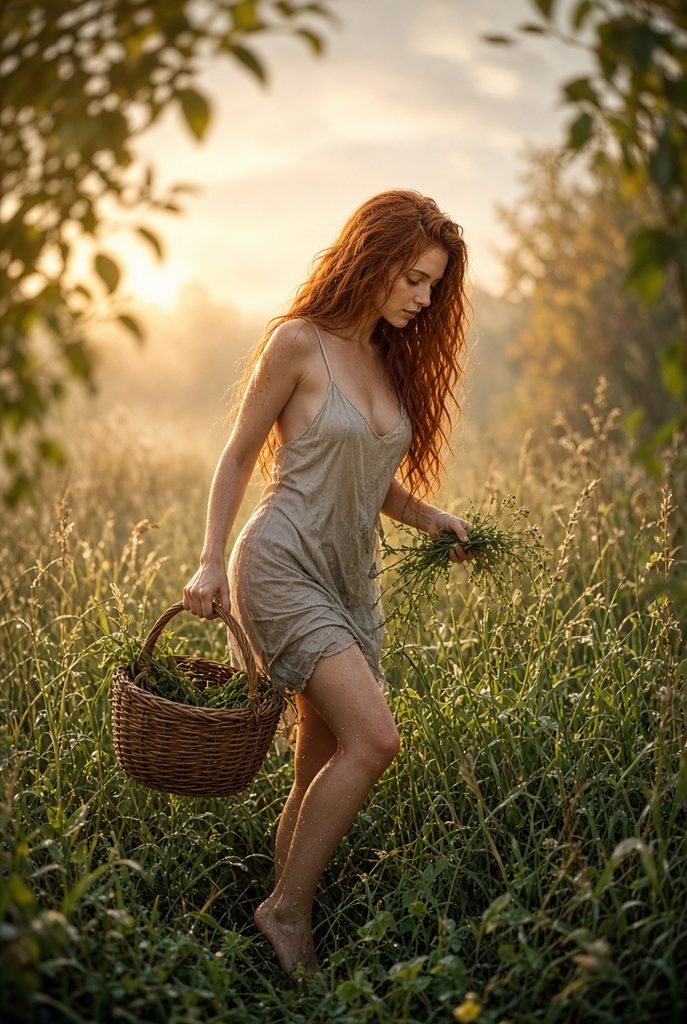
Before sunrise she stepped out naked beneath a thin linen shift that stuck to her skin with dew. The grass was cold enough to sting. She carried a willow basket on her hip and let the hem of the shift drag through the silvered stems. Mugwort brushed her shins and left a sharp green scent on the inside of her wrist. Rosemary crushed under her heel. Late blackberries stained the pad of her thumb when she lifted them, and she licked the juice away without thinking, tasting iron and night. At each gatepost she drew a small sign in the air with two fingers. The marks hung for a moment, darker than mist, then thinned. She did not command. She greeted. Some mornings the signs answered with a faint pressure against her palm, like a mouth that had not yet decided whether to kiss or bite.
The Books and the Kettle
Inside, she lit a beeswax candle and let the wax run. Steam from the copper kettle rose against her throat and collarbones. The books on the shelf smelled of damp and old animal glue. She turned pages with wet fingers, following the diagrams—stars folded into circles, circles into flowers, flowers into alphabets no living tongue still spoke. Condensation gathered on her lower lip. She did not wipe it away. The herbs steeped. The runes under the floor ticked once, very softly, against the joists.
Three Apples
Near midday the farmer came with windfallen apples. His hands shook when he set the basket down. The orchard had blackened at the roots. She listened, standing close enough that he could smell the rosemary on her skin and the warmer, saltier scent beneath it. When she handed him the pouch of dried leaves and the scrap of paper marked with a single protective rune, their fingers touched. His were cold. Hers were not. She took three apples and nothing else. After he left she stood in the doorway a moment longer, watching the place where his shadow had been, and the rune on the paper in his pocket grew warm against his chest all the way home.
Stones in the Soil
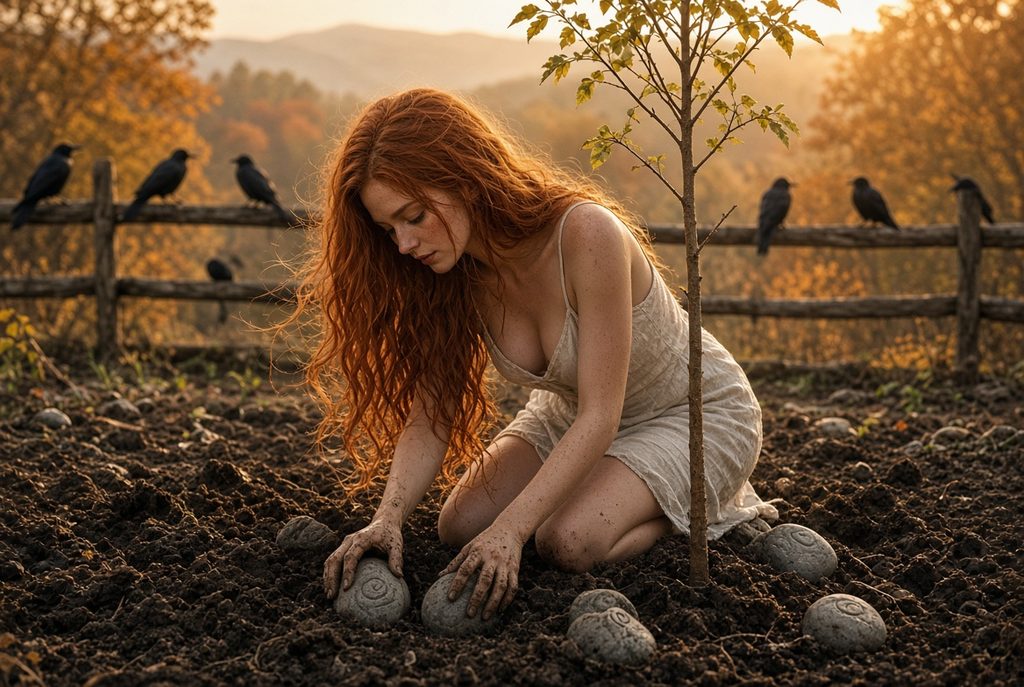
In the afternoon she worked the garden in the shift again, now damp at the hem and across the small of her back. She pressed carved stones into the soil around the young trees with the heel of her hand. The runes were simple—growth, endurance, the binding of root to weather—but the earth accepted them with a small, wet sound. Crows watched from the fence. One hopped closer than the others and tilted its head as if listening to the same low note she felt rising through her wrists. She did not look at it. She kept working until the soil under her nails was black and her shoulders ached in a way that felt like ownership.
Among the Standing Stones

At dusk she climbed the low hill beyond the cottage. The standing stones waited in their circle, older than the village and less interested in its prayers. She stood among them barefoot, the silver disk cool against her palm, and let the wind lift the hem of the shift against her thighs. The first stars pricked through. She did not speak. She listened to the grass, to the owl, to the distant bells, and to the older sound underneath them: the slow turning of something that had no name and no mercy. The disk reflected both the last light and the widening dark. For a moment the reflection showed her own face, and behind it another face that was not quite hers, mouth slightly open, eyes fixed on the same stars.
The Unlatched Door
When full dark came she walked back. The single candle in the window burned with a steady flame. Above the thatch the constellations wheeled, and if she stood very still in the yard she could feel the runes beneath the floor answering them—faint, rhythmic, almost like a pulse. She left the door unlatched. The night knew the way in.