
The first rule of espionage was not to lie.
That was what the little black notebook said, though the man who had written it had spent thirty years making lies look like weather.
Do not lie when silence will do. Do not speak when a question will do. Do not answer until you know who will pay for the answer.
Lily Venn had carried the notebook through four capitals, two undeclared wars, and one divorce that had been blamed on the weather.
Venn was not the name on her birth certificate. She had been born Lily Voss in a quiet German town where people locked their doors at night and preferred not to discuss what their grandparents had done for a living.
Her father had been a civil servant who believed that institutions must be protected, even when their leaders were corrupt. Her mother kept old letters in a locked drawer and occasionally burned one without explanation.
Lily had learned early that the past was not always forgotten. Sometimes it was managed.
She had entered Germany’s foreign intelligence service believing that careful people could protect the truth from powerful people. Years later, she understood that institutions were often most dangerous when staffed by people who sincerely believed they were doing good.
Beneath the notebook’s rules, someone had written a quotation without attribution:
He who has a why can bear almost any how.
Lily distrusted quotations. The dead were forever being recruited to justify the living.
She distrusted invulnerability even more. It was usually vanity wearing body armor.
She was in Prague when the summons came.
At 2:13 a.m., her secure phone illuminated the nightstand. No ring, no vibration. Just a line of green text.
THE TIGER HAS ENTERED THE GARDEN

Beneath it was a location: the old astronomical clock, west entrance, 4:00 a.m.
Lily read the message twice, turned the phone facedown, and got out of bed. She drank a glass of water, opened the notebook, and wrote:
I will not permit urgency to choose my character.
Then she slept for another ninety minutes.
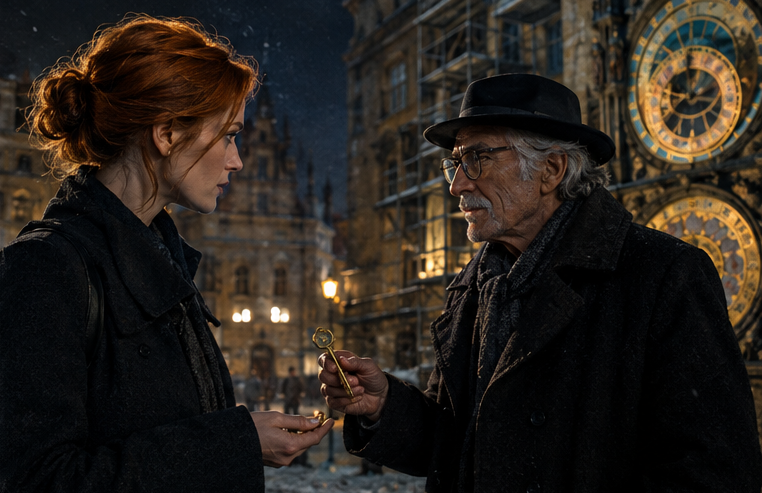
At 3:47, she walked through the sleeping city in a charcoal coat. Snow had turned the tram wires into black lines across the sky. Somewhere beyond the river, a church bell struck the wrong hour.
The astronomical clock stood beneath scaffolding. A workman’s van waited at the curb.
Lily passed it without looking.
“Your shoes are wrong,” said a voice behind her.
“Then you’re not my contact.”
“The left sole contains a transmitter.”
“It contains a nail.”
“Both can be useful.”
She turned. The man was small, elderly, and dressed like a professor who had misplaced his university. His gray mustache trembled in the cold.
“Professor Sayegh.”
“Formerly.”
“Formerly what?”
“Everything that matters.”
Lily almost smiled.
“Who sent you?”
“Someone who is now dead.”
“Which someone?”
“The one who knew your name before you changed it.”
He placed a brass key in her palm. It was warm from his pocket.
“The Meridian Archive,” he said. “They intend to activate it tomorrow night.”
“That’s a story designed to make me run.”
“Perhaps. But running may be the correct response.”
“What is the Archive?”
“A machine for deciding which version of reality the public will remember.”
He spoke quietly, as if the city itself might be listening.
“Election records, satellite imagery, financial ledgers, hospital registries, court transcripts. Not simply altered. Harmonized. A million contradictions made to agree. Once the system is running, fabricated evidence will appear to corroborate itself. The dead will be made to confess. The innocent will be remembered as traitors.”
“Who controls it?”
“Frightened men who have concluded that freedom is an administrative error.”
“And you want me to steal it?”
“I want you to prevent it from becoming a god.”
Lily turned the key over in her fingers.
“There is a file inside called the Ninth Cabinet,” Sayegh continued. “It contains evidence that Minister Korda, the celebrated reformer, ordered the disappearances. If the Archive goes live, those records will be rewritten.”
“Why me?”
“Because you still know the difference between power and truth.”
“That isn’t a qualification. It’s a liability.”
“Yes,” he said. “That is why you may be the only one left.”
An empty bus rolled past. When Lily looked back, the professor had vanished.
She did not search for him. Search was a form of panic with a professional vocabulary.
Instead, she walked to the river and watched fragments of ice drift beneath the bridges.
The tiger, she thought, was not the state, the machine, or even Korda. It was the pressure to become whatever the moment rewarded. It was the temptation to surrender the self in small, reasonable pieces and call the surrender necessary.
She had spent years learning to ride it.
Now she wondered whether she had mistaken balance for consent.
By dawn, Lily had confirmed three facts.
The Meridian Archive occupied a decommissioned telecommunications station beneath the eastern rail yards. Minister Korda’s security director was Elias Rook, a man Lily had once loved and later betrayed in a report that saved seventeen lives. The activation ceremony would take place at midnight, disguised as a private concert for ministers, industrialists, and generals.
The fourth fact was worse.
Someone inside her own service had leaked the operation.
Director Halden received her report without blinking. He was a broad, careful man whose silences had the quality of locked doors.
“Your source is dead?”
“Probably.”
“Your intelligence is unverified?”
“Partly.”
“Your proposed operation requires entry into a sovereign installation, theft of classified material, and possible damage to infrastructure supporting regional emergency systems.”
“Yes.”
“And you expect us to proceed on the testimony of a dead man?”
“No. I expect us to proceed because our own traffic analysis shows the same architecture.”
Halden studied her for a long moment.
“You have thirty-six hours to prove the Archive exists. Then I’ll decide whether to authorize anything.”
“And if you don’t?”
“Then you will obey.”
Lily opened her notebook and underlined the word obedience.
Halden noticed.
“You’re not the only person who has read Nietzsche, Venn.”
“No,” she said. “But perhaps I’m the only one who remembers that he was warning us.”
She left before her mouth could become a weapon.
For the next twelve hours, she worked without drama. She walked rather than took a car. She ate bread, cheese, and an apple in a crowded café. She called an old colleague and asked for one favor, not three. She read the technical reports, then read them again.
The discipline was not spiritual decoration. It was counterintelligence.
Fatigue made her careless. Hunger made her impatient. Constant stimulation made every manufactured crisis feel urgent. A notebook gave her somewhere to put a thought without immediately believing it.
At nine that evening, she recorded three lines.
Success: Found an access discrepancy in the rail-yard plans.
Failure: Wanted Halden’s approval more than I wanted the truth.
Correction: Make the next decision as if no one will praise it.
The seventeen people came back to her as she closed the notebook.
She had been thirty-two when their names first appeared in a counterintelligence file. They were suspected of assisting a foreign network operating across central Europe. The evidence seemed conclusive until Lily noticed that several reports quoted the same source while pretending to corroborate one another.
She warned her superiors. They told her the operation could not wait.
She investigated anyway.
The evidence had been manufactured to protect an informant whose continued usefulness mattered more to the service than the lives of seventeen people. When Lily filed her report, the operation collapsed. The detainees were released, and a parliamentary inquiry followed.
The report also exposed the role played by Elias Rook, who had approved an intelligence assessment without asking where its most damaging claims originated.
He told her he had trusted her judgment.
She told him that trust was not a substitute for evidence.
They had both been right. It had not saved them.
Rook lost his position. Lily’s identity was compromised, and her career in the service ended under circumstances neither side wished to explain publicly. She adopted the surname Venn and continued working in the shadows, first as a contractor, then as an independent intermediary whose loyalties were difficult to establish.
She had saved seventeen lives.
She had also enjoyed, for one shameful moment, the knowledge that she alone had seen through the deception.
That was the part she had never confessed to Elias.
At 11:40 p.m., Lily entered the rail yard through a drainage culvert carrying a stolen maintenance badge and a revolver she hoped not to use.
The station had been built during the Cold War and renovated by men who believed concrete was a moral virtue. Pipes crossed the ceiling like black veins. Cameras turned above sealed doors. The air smelled of wet stone and electrical insulation.
At the first checkpoint, Lily presented the badge.
The guard examined it, then looked at her.
“You’re early.”
“I was told to be late.”
He hesitated.
“By whom?”
“By the person who told you to ask.”
His expression changed by a fraction.
In espionage, a fraction could be a confession.
Lily struck him beneath the jaw. He folded. She caught him before his head hit the concrete and lowered him carefully to the floor.
Strength, she had learned, was not the capacity to destroy. It was the capacity to stop destroying once the objective had been achieved.
She moved on.
At the next security door, the stolen badge failed. A red light blinked above the reader.
Then another light came on farther down the corridor.
She had thirty seconds, perhaps less.
Lily took out Sayegh’s brass key and inserted it into an old mechanical lock concealed beneath the electronic panel. For a moment, nothing happened.
Then the door released with a heavy metallic click.
Beyond it, the Meridian Archive hummed.
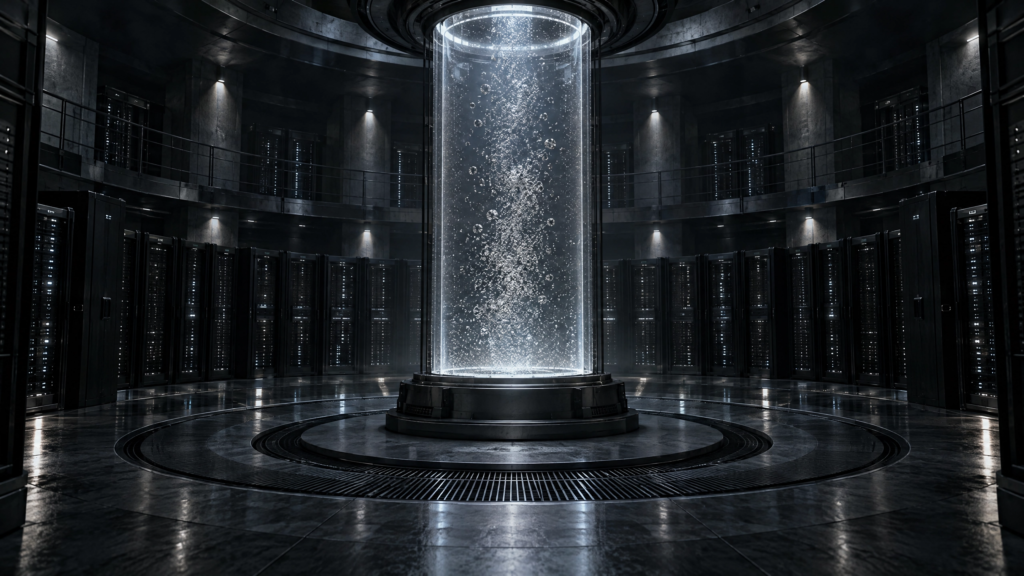
It was not a supercomputer in the theatrical sense. No glowing sphere, no cathedral of screens. Dark cabinets stood in concentric rows around a circular chamber. In the center was a transparent column filled with silver particles that fell slowly upward.
A man waited beside it in a white dinner jacket.
Elias Rook’s hair had gone gray at the temples. He looked exactly as he had the last time Lily saw him, except that hope had disappeared from his face.
“You always did prefer the back entrance,” he said.
“You always did prefer an audience.”
“The ministers are upstairs. They believe they’re attending a concert.”
“What are they hearing?”
“An orchestra playing a piece composed by a machine that has never heard music.”
Lily raised the revolver.
“Move away from the controls.”
Rook glanced at the weapon.
“You won’t shoot me.”
“Confidence isn’t evidence.”
“It’s knowledge.” He touched the glass column. “You are still governed by the old morality.”
“Which old morality?”
“The morality of limits. Equal dignity. Truth as something more valuable than victory.”
“You say that as if it were an insult.”
“It is an obstacle.”
He stepped closer.
“Do you know what happens when frightened populations are given unlimited access to reality? They fracture. They elect the loudest liar. They burn the library, then ask why the books weren’t loyal. We can prevent this.”
“By deciding what everyone remembers?”
“By giving history a spine.”
“History isn’t a bodyguard.”
“History is a weapon. We are simply taking it out of the hands of children.”
Lily understood then that Rook believed himself merciful. That was the most dangerous kind of fanaticism: cruelty mistaken for hygiene.
“Where is the Ninth Cabinet?”
He smiled.
“You haven’t come to destroy the Archive.”
“No.”
“You’ve come to steal the evidence.”
“If possible.”
“And if not?”
“I’ll stop the activation.”
“By force?”
“By necessity.”
He laughed softly.
“You used to believe necessity was the language of people who wanted permission.”
“I still do.”
“Then why are you here?”
Lily lowered the revolver a fraction.
“Because permission isn’t the same as justification.”
For the first time, he looked wounded.
“Lily Voss,” he said quietly. “Do you ever wonder whether you changed your name because you wanted to escape the service, or because you wanted to escape the person who was right about you?”
She felt the words before she understood them.
“You don’t get to use my name.”
“It’s your name.”
“It was.”
“No,” he said. “It’s the one you gave me when you still believed I knew you.”
For an instant, the chamber seemed to fall away. She remembered a small apartment in Berlin, rain against the windows, Rook asleep in a chair with a book open on his chest. She remembered thinking that intimacy meant being known, and that being known was a kind of safety.
Then she remembered the report. The seventeen names. The silence that followed.
“You approved the assessment,” she said.
“I did.”
“And you never checked the source.”
“I trusted the people who gave it to me.”
“That isn’t an answer.”
“No,” he said. “It isn’t.”
He moved.
A blade flashed from his sleeve. Lily turned, felt the cut open her coat, and drove her shoulder into his chest. They slammed against the railing around the silver column. The particles inside whirled upward.
Rook caught her wrist and twisted. The revolver clattered across the floor.
“You think self-mastery makes you free,” he whispered. “It only makes you useful to whoever aims you.”
“Perhaps.”
She stamped on his foot, broke his grip, and struck the wound beneath his collarbone. He staggered back.
Lily did not pursue him.
He stared at her in disbelief.
“What’s the matter?” she asked. “Did you expect me to finish you?”
He said nothing.
“That’s the part you never learned.”
She turned to the console.
The Archive demanded biometric authorization. Lily used the blood on her glove, and the system opened.
Files unfolded across the screen: names, dates, coordinates, orders. The Ninth Cabinet appeared at the bottom of the directory.
She copied it to a thin encrypted drive.
Then she saw another folder.
CONTINGENCY: PUBLIC DISCLOSURE.
Inside were thousands of sealed records: secret prisons, forged elections, murdered informants, financial arrangements between governments and private armies.
Not just Korda’s crimes. The crimes of every government that had funded the Archive, including her own.
Lily understood the trap.
Release everything, and the guilty might fall—but innocent witnesses could be exposed, emergency systems disrupted, and frightened people driven toward violence.
Destroy everything, and Korda would survive behind a manufactured history.
Take only the Ninth Cabinet, and she would preserve the machine’s power while becoming another custodian of selected truth.
The tiger had brought her to a fork in the river and called every direction virtue.
Behind her, Rook was crawling toward the fallen revolver.
Lily opened the distribution protocol.
She selected records supported by independent evidence: signed orders, financial transfers, detention rosters, and corroborated testimony. She excluded the identities of vulnerable witnesses and records whose authenticity could not yet be established.
She scheduled the material for staggered release through independent courts, newspapers, and humanitarian organizations in six countries.
Then she enabled the audit trail, including her own government’s involvement.
Rook reached the revolver.
A shot struck the ceiling.
Lily seized the emergency cutoff and pulled it.
The silver column went dark.
Above them, the concert stopped.
For three seconds, the underground station was silent. Then alarms began to howl.
Rook pointed the revolver at her. His hand shook.
“You’ve condemned millions to uncertainty.”
“No,” Lily said. “I’ve refused to make uncertainty a crime.”
He fired.
The bullet struck the console. Sparks burst across the chamber. Lily threw herself behind a cabinet as the lights failed.
In the darkness, she heard Rook breathing. Then footsteps on the stairs. Security teams descending—Halden’s people, Korda’s, or both.
Lily took the drive from her pocket and held it between two fingers.
A small object. A world of leverage.
She could keep it. Disappear. Become the one person who knew the whole map. Knowledge could be a private kingdom, and private kingdoms made even honest people resemble tyrants.
She inserted the drive into the emergency transmitter.
“Do you know what you’re doing?” Rook asked.
“Yes.”
“They’ll hunt you.”
“Yes.”
“You’ll lose your name.”
“I changed it once.”
“And what will remain?”
Lily thought of the notebook. Of the line about the why. Of the possibility that strength was not standing above others, but remaining answerable to them.
“Enough,” she said.
She pressed SEND.
The evidence went out in encrypted fragments to people who could challenge it, verify it, and act upon it. The truth did not arrive as revelation. It arrived as work: frightened witnesses, legal petitions, public arguments, corrections, denials, more evidence.
It became difficult rather than holy.
That was how Lily knew it might survive.
The stairwell door opened. White light filled the chamber.
Rook was gone.
Beside the darkened column lay the brass key.
Lily picked it up and closed her hand around it.
Three days later, Minister Korda resigned. Two days after that, he vanished. The governments involved issued denials in nearly identical language, which made them easy to compare.
An international tribunal seized the Archive’s remaining servers. Director Halden was suspended pending investigation.
Lily Venn was declared missing.
This was useful. It gave her time to become someone else.
On the sixth morning, in a town beyond the border, she rented a room above a bakery. She slept until eight. She walked for twenty minutes. She ate eggs without a screen and read ten pages of a book she did not understand.
Then she opened the black notebook.
Success: I refused to let the powerful claim ownership of the truth.
Failure: I enjoyed deciding how much of it the world could bear.
Correction: Trust no philosophy that flatters the hand holding the knife.
She paused before adding one final line.
Tomorrow: find the professor.
Outside, a woman argued with a child about a red scarf. A truck groaned uphill toward the market. Behind the bakery window, bread cooled in the morning light.
Nothing had been purified. The powerful had not disappeared, and the world had not become just. One machine had been stopped. The temptation that built it remained.
Lily put on her coat.
The tiger was still running.
She followed.